From 3½ yearsPremium4 difficulty levels
Your child picks up a shape and drops it in the right silhouette, with several silhouettes side by side. Only the shape matters: each piece has its colour, the silhouettes are grey.
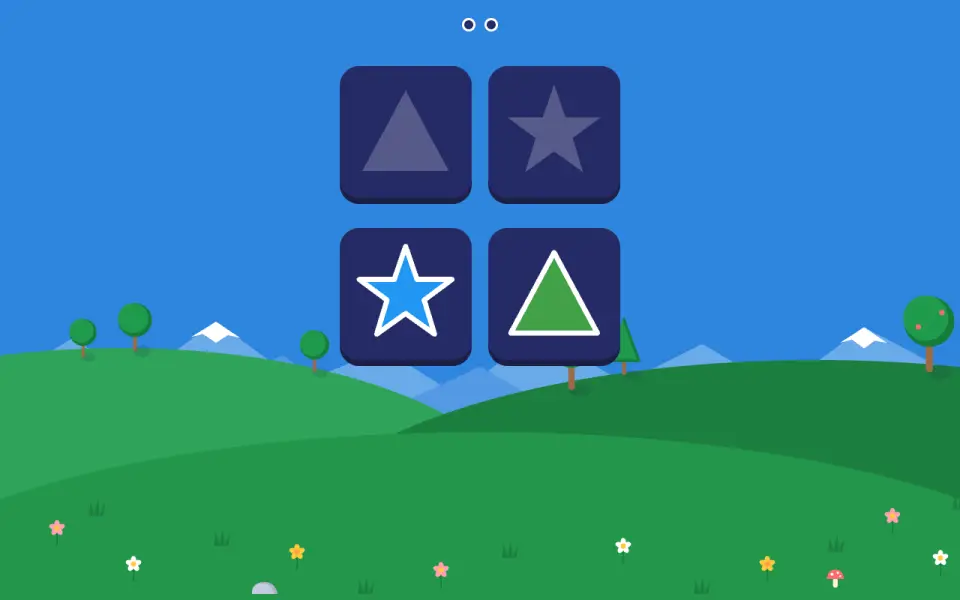
What your child practices
- Place an object in a precise spot
The level goes up on its own after two successful games in a row.
Why “Shape puzzle” is designed this way
What if my child has trouble telling colours apart?
Supported by studiesNo instruction relies on colour alone: a shape, a size or a position always goes with it.
Between 1 and 6% of preschool-age children, depending on the source, have difficulty telling some colours apart.
What the studies do not say: The games whose very aim is to learn colours are an exception: “Find the colour”, and “The balloons” from level 4.
Sources
- Xie et al., 2014. Color vision deficiency in preschool children, Ophthalmology. Age studied: preschool age.
What happens when my child gets it wrong twice?
Our reasoned choice, as a precautionAfter a first mistake, the bunny encourages and repeats the instruction. After the second, the right answer starts to move gently and the bunny points to it.
A child who cannot find the answer should not stay stuck or guess at random: they finish each question on a success. A question found with help does not count as passed in their record.
No study covers this exact point. We found no study on how many mistakes to allow before helping, at this age and on a screen. Two is our choice.
How we check it. For the same question, we compare success without help the next time. If help comes too early for the child to learn, we will delay it.
The rules shared by all the games are explained in Our method: why does my child never have to drag an object ; why is the arrow so big, and why does it turn red ; why are the buttons and objects so big ; why these deep colours ; what happens when my child makes a mistake.
In the same area
In the computer’s browser, on a Mac or PC. Nothing to install.