From 3 yearsIncluded in the free version4 difficulty levels
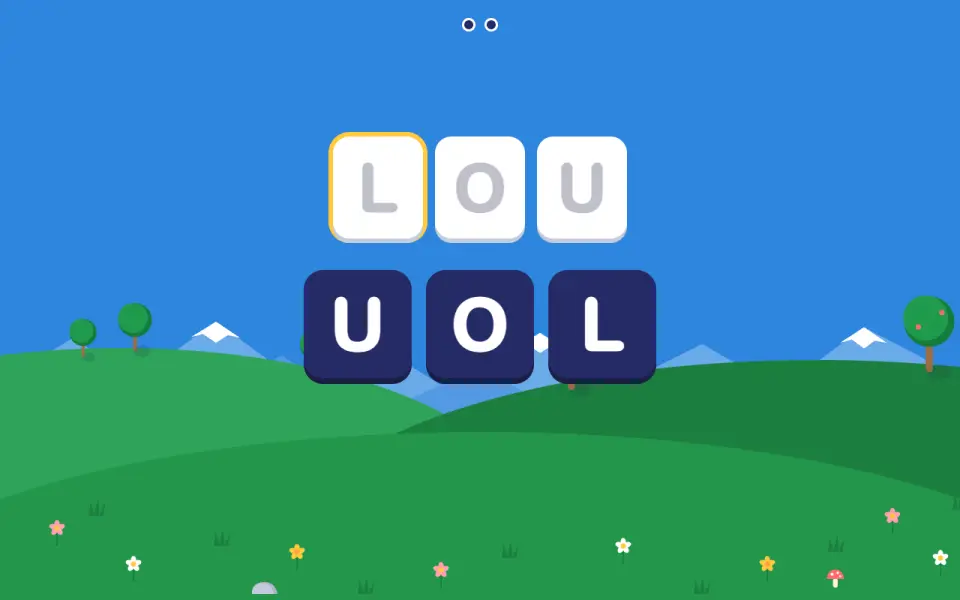
Your child clicks the letters of their name, in order, to fill the boxes. At later levels extra letters are added, then the boxes of the name stay hidden. After two mistakes on the same letter, the right one is gently pointed out.
What your child practices
- Recognise the first letter of their name
The level goes up on its own after two successful games in a row.
Why “My name” is designed this way
What happens when my child gets it wrong twice?
Our reasoned choice, as a precautionAfter a first mistake, the bunny encourages and repeats the instruction. After the second, the right answer starts to move gently and the bunny points to it.
A child who cannot find the answer should not stay stuck or guess at random: they finish each question on a success. A question found with help does not count as passed in their record.
No study covers this exact point. We found no study on how many mistakes to allow before helping, at this age and on a screen. Two is our choice.
How we check it. For the same question, we compare success without help the next time. If help comes too early for the child to learn, we will delay it.
When is a skill considered mastered?
Our reasoned choice, by extension of a related studyA skill is called mastered after three successes out of the last four attempts, on two different days.
We only move on once the foundation is in place; aiming for frequent but not total success keeps the exercise useful.
No study covers this exact point. No threshold has been measured in children under 6. The 85% rule comes from computer models.
How we check it. We check that a skill declared mastered stays so when it returns a few days later. If not, the threshold will be raised.
The closest we found
- Kulik, Kulik, Bangert-Drowns, 1990. Effectiveness of mastery learning programs: a meta-analysis, Review of Educational Research. Age studied: school and university.
- Wilson, Shenhav, Straccia, Cohen, 2019. The Eighty Five Percent Rule for optimal learning, Nature Communications, 10. Age studied: learning models, not children.
- French Ministry of National Education (Ministère de l’Éducation nationale), 2024. Programme de l’école maternelle (French preschool curriculum; Bulletin officiel no. 41 of 31 Oct 2024, consolidated in Bulletin officiel no. 19 of 7 May 2026). Age studied: 3 to 6 years.
The rules shared by all the games are explained in Our method: why are the buttons and objects so big ; why do objects never come to the pointer ; what happens when my child makes a mistake ; why these deep colours ; why does the bunny never say “you are strong” ; why is everything spoken aloud.
In the same area
In the computer’s browser, on a Mac or PC. Nothing to install.