From 3 yearsIncluded in the free version
The bunny names a colour and your child clicks the right patch. It relies entirely on colour, like the balloons from level 4: turn it off if your child has trouble telling colours apart.
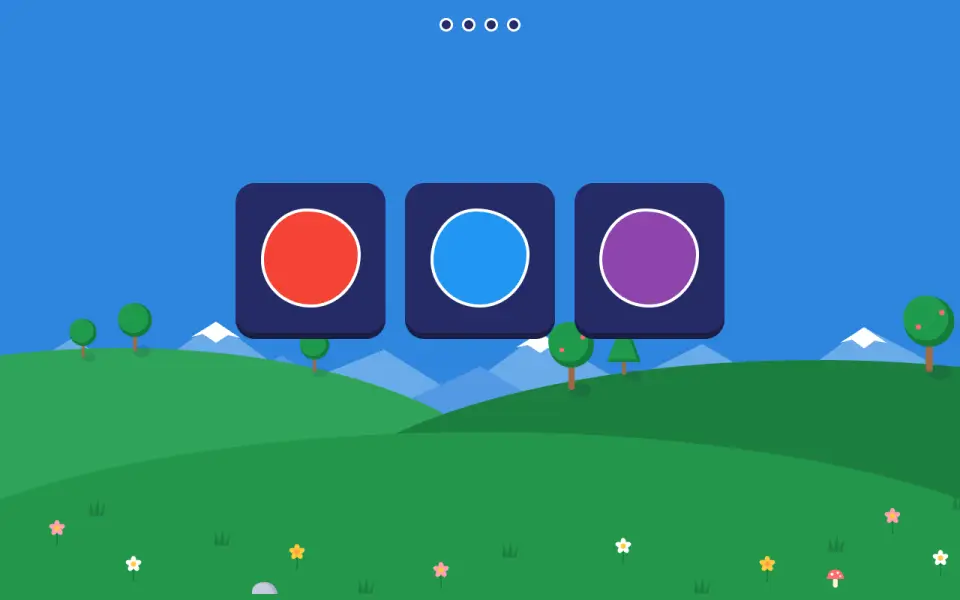
What your child practices
- Recognise a colour by its name
Why “Find the colour” is designed this way
What happens when my child gets it wrong twice?
Our reasoned choice, as a precautionAfter a first mistake, the bunny encourages and repeats the instruction. After the second, the right answer starts to move gently and the bunny points to it.
A child who cannot find the answer should not stay stuck or guess at random: they finish each question on a success. A question found with help does not count as passed in their record.
No study covers this exact point. We found no study on how many mistakes to allow before helping, at this age and on a screen. Two is our choice.
How we check it. For the same question, we compare success without help the next time. If help comes too early for the child to learn, we will delay it.
Why an exercise on colours, if nothing is supposed to rely on colour?
Our reasoned choice, by logicTwo games ask the child to recognise a colour by its name: “Find the colour”, and “The balloons” from level 4. Everywhere else, colour is never the only clue.
Naming colours is part of what is expected of a child in French preschool (école maternelle): it cannot be practised without colour itself. The exercise is therefore set apart, announced as such, and you can turn it off.
No study covers this exact point. A child who has trouble telling colours apart will fail it without it being a delay: it is up to you to turn it off, the software does not detect it.
How we check it. We look at whether a child’s mistakes always involve the same pairs of colours (red and green, for example), to flag it to you.
Where does the exercise programme come from?
Established by researchThe skills and their order follow what the official French, English and American curricula have in common for ages 3, 4 and 5.
These three texts agree on the essentials: the sounds of the language, letter names, counting, small quantities, shapes and patterns.
Sources
- French Ministry of National Education (Ministère de l’Éducation nationale), 2024. Programme de l’école maternelle (French preschool curriculum; Bulletin officiel no. 41 of 31 Oct 2024, consolidated in Bulletin officiel no. 19 of 7 May 2026). Age studied: 3 to 6 years.
- Department for Education (England), 2026. Early years foundation stage statutory framework. Age studied: 0 to 5 years.
- Head Start (United States), 2015. Head Start Early Learning Outcomes Framework. Age studied: 0 to 5 years.
The rules shared by all the games are explained in Our method: why are the buttons and objects so big ; why do objects never come to the pointer ; what happens when my child makes a mistake ; why is everything spoken aloud ; why does the bunny never say “you are strong” ; why these deep colours ; why is the background so calm during an exercise.
In the same area
In the computer’s browser, on a Mac or PC. Nothing to install.